

What Is a Buffer Vessel and How Does It Improve Energy Efficiency in Commercial Buildings
In commercial buildings, energy efficiency is rarely achieved through a single piece of equipment or one sweeping change. More often, it comes from a collection of components working together intelligently, each one playing a specific role in reducing waste and improving overall system performance.
Buffer vessels don’t always get the recognition they deserve in that conversation, they’re not the most glamorous piece of kit in a commercial plant room, and they don’t generate heat themselves. But in terms of their contribution to heating system efficiency, they punch well above their weight.
For facilities managers and building operators looking to reduce energy consumption without comprising on comfort or reliability, understanding what a buffer vessel does and what it costs when one isn’t working correctly, is well worth the time.
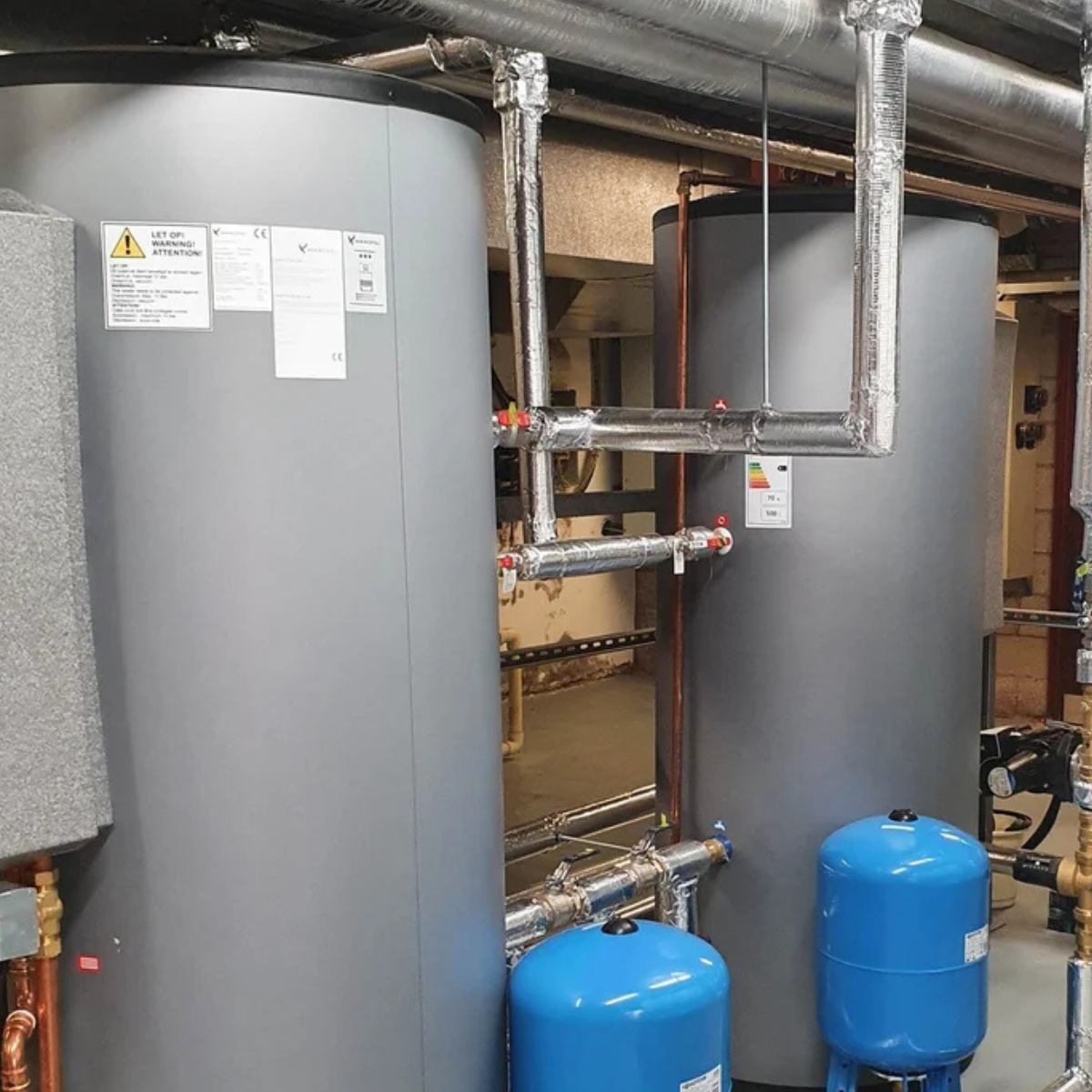
What is a Buffer Vessel?
A buffer vessel is an insulated vessel that stores heated water within a commercial heating system. It sits between the heat source, a boiler, heat pump, or similar equipment, and the distribution circuit that delivers warmth across the building.
Its role is not to product heat, instead it hold a volume of hot in reserve, acting as a thermal store that the system can draw from as demand rises and falls throughout the day. In energy efficiency terms, that distinction matters more than it might initially appear.
The Short Cycling Problem
To understand how a buffer vessel improves efficiency, it helps to understand the problem it exists to solve.
When a commercial heating system has no thermal storage, the heat source responds directly to every fluctuation in building demand. In a large or complex building, that demand changes constantly, as zones heat up, thermostats satisfy, occupancy shifts, and external temperatures vary throughout the day.
Without a buffer, this means the boiler or heat pump switches on and off repeatedly in short bursts, never completing a full, efficient heating cycle. This is known as short cycling, and it is one of the most significant sources of unnecessary energy consumption in commercial heating systems.
Short cycling doesn’t just waste energy, it accelerates wear on the heat source, increases maintenance requirements, and shortens equipment lifespan, adding cost in multiple directions simultaneously.
How a Buffer Vessel Addresses This
A buffer vessel breaks the direct link between moment-to-moment building demand and the heat source’s operating cycle.
Instead of responding to every small fluctuation, the boiler or heat pump runs for longer, more sustained periods, charging the tank with stored thermal energy. When building calls for heat, it draws from the tank first. The heat source only needs to operate again once the stored energy has been sufficiently depleted.
The practical result is fewer start-stop cycles, longer and more efficient run times, and a heating system that operates closer to its designed performance parameters. In buildings where heating demand is variable or unpredictable, the efficiency gains can be substantial.
The Hidden Cost of a Poorly Performing Buffer Vessel
Buffer vessel are robust pieces of equipment, but they are not maintenance-free. When they develop problems, whether through insulation degradation, sediment accumulation, incorrect sizing, or poor system integration, the efficiency benefits they’re supposed to deliver quietly disappear.
A buffer vessel that isn’t retaining heat effectively forces the heat source to run more frequently, and a thank that has accumulated sediment loses usable storage capacity. A vessel that is incorrectly integrated into the system’s flow and return circuits may fail to buffer demand at all, leaving the heat source to short cycle regardless of the tank’s presence.
In each of these scenarios, energy consumption rises, and the heat source works harder than it should. The problem could persist undetected for a considerable amount of time, because the connected between a poorly performing buffer tank and rising energy bills isn’t always obvious.
What Maintenance Should Cover
For facilities teams managing commercial buildings with buffer vessel installed, ensuring they form part of a structured maintenance programme is essential to preserving their efficiency contribution.
Planned maintenance visits should include:
Inspection of insulation condition and integrity
Checks on flow and return connections and temperature differentials
Assessment of associated expansion vessels and pressurisation equipment
Verification that the tank remains correctly sized and configured for the current system
Monitoring for sediment accumulation where applicable
If a building’s heating system has been modified or extended since the buffer vessel was originally installed, it’s also worth confirming that the vessel’s capacity remains appropriate for the updated system. An undersized vessel provides limited buffering benefit, while an oversized vessel may introduce its own inefficiencies.
Final Thoughts
Buffer vessels are a quiet but genuinely significant contributor to commercial heating efficiency. By protecting the heat source from short cycling, enabling longer and more consistent run times, and providing thermal storage that smooths out the peaks and troughs of building demand, they help commercial heating systems operate closer to their designed potential.
For facilities managers focused on reducing energy consumption, controlling operational costs, and getting the best possible performance from their heating systems, keeping buffer vessels properly maintained and correctly configured is one of the most effective steps available.
At William Austin, we work with businesses and facilities team across the UK to maintain, assess, and optimise commercial heating systems, including the buffer tanks and associated plant that play such an important role in system efficiency. If you’d like guidance on the performance of your heating system, our team is always happy to help.
Written by Will Judd
Published: 05/04/2026