

What Are VRF Outdoor Units and Why Are They Used in Commercial Buildings?
Walk around the rooftop or external plant area of almost any modern commercial building in the UK and the chances are you'll encounter them. Large, rectangular, quietly humming units, banks of them in some cases, connected to the building by insulated refrigerant pipework running through the fabric of the structure.
For facilities managers who didn't commission the original installation, these units can be something of a mystery. They're clearly doing something important. But exactly what, and why they're specified over alternative systems, isn't always clear.
These are VRV, trademarked by Daikin, outdoor units, and understanding what they do is increasingly important for anyone responsible for managing a modern commercial building.
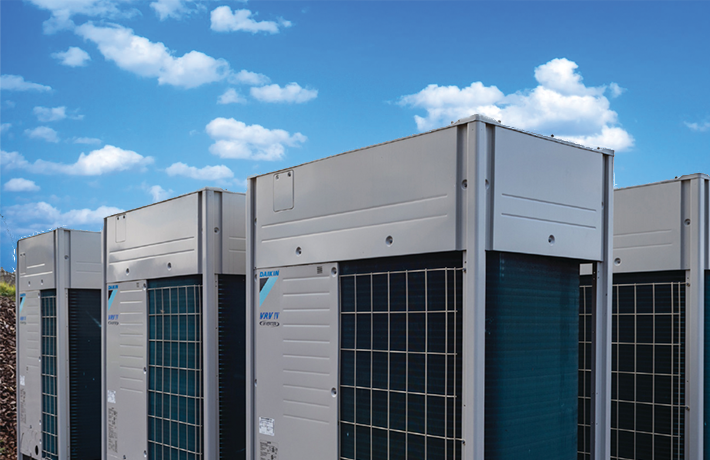
Image Credit: Daikin
What Does VRV Stand For?
VRV stands for Variable Refrigerant Volume. It's a term originally trademarked by Daikin, who pioneered the technology, and it refers to the system's ability to vary the volume of refrigerant circulating through the pipework in response to the real-time heating and cooling demands of the building.
You'll also find the term VRF, Variable Refrigerant Flow, which describes the same fundamental technology and is used by other manufacturers. In practice, VRV and VRF refer to the same category of system. The distinction is largely one of branding rather than engineering.
What Do They Actually Do?
The outdoor unit is the heart of a VRF system. It houses the compressor, the heat exchanger, and the controls that manage refrigerant flow throughout the entire system.
In cooling mode, the outdoor unit rejects heat drawn from inside the building out into the external air. In heating mode, it extracts heat energy from the outside air, even at low ambient temperatures, and transfers it into the building via the refrigerant circuit.
Connected to the outdoor unit by refrigerant pipework are multiple indoor units, installed throughout the building in the spaces that require heating or cooling. Each indoor unit operates independently, responding to the demand from its own zone without affecting the others.
The outdoor unit reads those demands continuously and adjusts refrigerant flow accordingly, delivering precisely the right amount of heating or cooling to each zone at any given moment. This is what the variable volume element of VRF refers to, and it's the characteristic that makes these systems significantly more efficient than conventional fixed-output alternatives.
Why Are They so Common for UK Commercial Buildings?
The growth of VRF systems across the UK commercial sector over the last fifteen years reflects several practical advantages that are difficult to match with alternative technologies.
Flexibility is the most significant. A single outdoor unit, or a group of outdoor units connected together, can serve dozens of indoor units distributed across multiple floors and zones. Each zone is independently controlled, meaning different areas of the building can maintain different temperatures simultaneously without compromising system efficiency.
This makes VRF particularly well suited to the kind of mixed-use, multi-zone commercial buildings that are now standard across the UK, offices where meeting rooms, open-plan areas, server rooms, and reception spaces all have different thermal requirements throughout the day.
The refrigerant pipework that connects outdoor and indoor units is also relatively compact compared to the ductwork required by traditional air handling systems, making VRF a practical choice in buildings where ceiling and riser space is limited.
Heat Recovery - A Key Capability
The most advanced VRF outdoor unit configurations offer heat recovery operation, one of the technology's most compelling efficiency features.
In a heat recovery system, the outdoor unit can simultaneously supply heating to some zones and cooling to others. Heat extracted from spaces being cooled is redirected to spaces requiring warmth rather than being expelled to the outside air. In a large commercial building where server rooms require constant cooling while perimeter offices need heating on a cold day, this simultaneous operation can deliver substantial energy savings compared to running separate heating and cooling systems.
For UK commercial buildings under increasing pressure to demonstrate energy efficiency and reduce carbon output, heat recovery VRF represents a meaningful step forward, and it's one reason why these systems are increasingly specified in new build and refurbishment projects across the country.
What Facilities Teams Should Know About Maintenance
VRF outdoor units are robust pieces of equipment designed for continuous operation across many years. But like all mechanical plant, they perform best and last longest when properly maintained.
Key maintenance considerations for VRF outdoor units include:
Regular cleaning of condenser coils to maintain heat exchange efficiency
Checks on refrigerant charge and system pressures to identify any developing leaks
Inspection of electrical connections, inverter drives, and compressor operation
Verification of controls and communication between outdoor and indoor units
F-Gas compliance checks, including leak detection records required under UK F-Gas regulations
F-Gas obligations in particular are worth highlighting. VRF systems use refrigerant under pressure, and UK regulations require that systems above certain refrigerant charge thresholds are checked for leaks at regular intervals by a registered engineer. Maintaining accurate F-Gas records is not just good practice, it's a legal requirement.
If a unit hasn't been serviced recently, or if the building's F-Gas records aren't current, addressing both should be a priority for any facilities team.
Engineering Challenges With VRF Systems
VRF systems are sophisticated pieces of equipment, and that complexity brings genuine engineering challenges. Refrigerant pipework design has to be calculated precisely, the lengths, diameters, and branch configurations all need to be correct to ensure proper distribution to every indoor unit. Errors at this stage can lead to inconsistent zone performance and increased energy consumption that's difficult to trace back to the original cause.
Fault diagnosis presents a similar challenge. Because a single outdoor unit serves multiple zones simultaneously, a performance issue in one area can have causes that originate elsewhere in the system entirely. This is why genuine VRF experience, not just general HVAC knowledge, matters when it comes to installation, commissioning, and ongoing maintenance.
What Happens When They Aren’t Performing?
Problems with a VRF outdoor unit rarely announce themselves dramatically. More commonly, performance degrades gradually, zones that were once well controlled become inconsistent, energy consumption rises quietly, and fault codes begin to appear on indoor unit controllers without an obvious cause.
Dirty condenser coils, refrigerant losses, compressor wear, and control communication faults are among the most frequent causes of declining VRF performance. In each case, early identification through planned maintenance is far preferable to waiting for a system failure that leaves multiple zones without heating or cooling simultaneously.
Final Thoughts
VRF outdoor units are at the core of some of the most capable and efficient commercial HVAC systems available in the UK today. Their ability to serve multiple independent zones from a single external plant installation, respond dynamically to real building demand, and, in heat recovery configurations, redistribute energy intelligently across a building makes them a compelling long term investment for commercial properties of all sizes.
But they deliver those benefits consistently only when they're properly maintained and supported by engineers who understand the technology.
At William Austin, we install, service, and maintain these systems for commercial buildings across the UK, working with facilities teams to keep these systems performing at their best throughout their operational life. If you'd like guidance on the maintenance or performance of your system, our team is always happy to help.
Written by: Will Judd